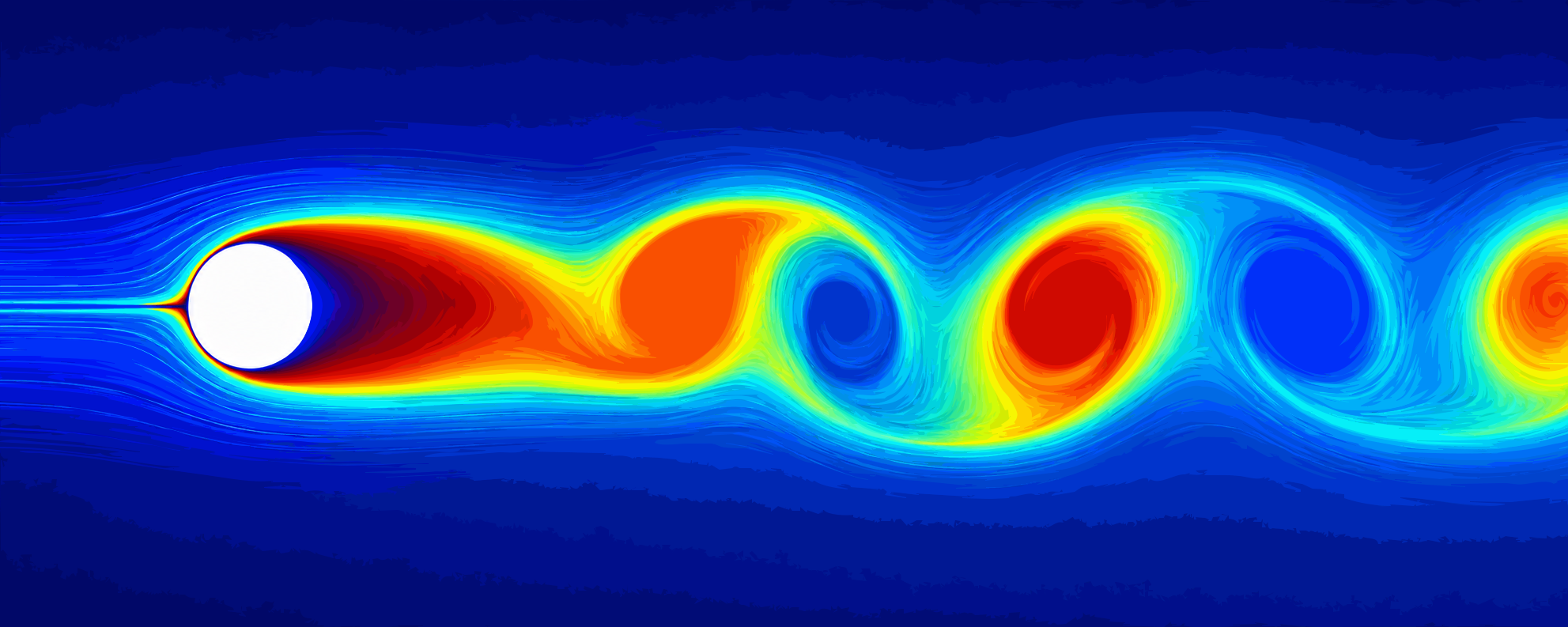
01. What is a Fluid?
Open Science. Open Fluids.
Dive into the core principles of fluid mechanics. This foundational course covers the essential concepts governing how fluids behave in motion and at rest. From Newton to Bernoulli, you'll explore the fundamental equations and principles that govern fluid flow, pressure distribution, and the behavior of fluids in various scenarios.
Additional lessons are currently being developed and will be available soon. Stay tuned for updates on our expanding curriculum, which will cover topics such as Gas Dynamics, Aero Dynamics, and Hypersonics.
OpenFluids is currently under active development
.png)
Fluid Dynamics
01. What is Fluid Dynamics?
Understand the fundamental concepts and principles that define fluid dynamics.
02. Dimensional Analysis
Learn how to use dimensional analysis to simplify complex fluid dynamics problems and derive key relationships.
03. Fluid Statics
Explore the behavior of fluids at rest, including pressure distribution and buoyancy effects.
Lesson Navigation
Table of Contents
What is a Fluid?
Understanding deformation and shear behavior.
Fluid Mechanics
The study of fluids at rest and in motion.
Open/Closed Systems
Control volumes and system boundaries.
Properties of Fluids
Density, viscosity, and thermodynamic properties.
Ideal Gas Law
Relating pressure, volume, and temperature.
Pressure
Normal stresses and pressure measurement.
What is a Fluid?
A fluid is a substance that flows and deforms continuously under an applied shear stress.

Shear Stress Explained
Shear stress is a force applied parallel to a surface, causing the material to deform laterally. In fluids, when a shear stress is applied, the fluid does not resist deformation the way a solid would. Instead, it flows continuously and indefinitely under the applied stress. This is the key characteristic that defines a fluid—its inability to resist shear forces and its tendency to flow rather than maintain a fixed shape.
Unlike solids, which maintain a fixed shape, fluids adapt to the container they occupy. This fundamental property distinguishes fluids into two categories: liquids and gases. Liquids are incompressible fluids with defined volumes but no fixed shape, while gases are compressible and expand to fill their entire container. In this lecture, we will explore the microscopic origins of fluid behavior, the distinctions between different fluid types, and why the study of fluid mechanics is essential for engineering and natural phenomena.
Solids
Shape: Fixed
Volume: Fixed
Compressibility: Incompressible
Shear Resistance: Strong
Maintain fixed shape and volume; resist shear stress and deformation.
Liquids
Shape: Adapts to container
Volume: Fixed
Compressibility: Incompressible
Shear Resistance: Minimal
Flow to fill container but maintain constant volume; no shear resistance.
Gases
Shape: Adapts to container
Volume: Variable
Compressibility: Highly compressible
Shear Resistance: None
Expand to fill entire container; highly compressible with no resistance to shear.
Fluid Mechanics.
The field of applied mechanics concerned with the behavior of fluids (liquids and gases) at rest or in motion is known as Fluid Mechanics.
Fluid Mechanics
The field of applied mechanics concerned with the behavior of fluids at rest (Fluid Statics) or in motion (Fluid Dynamics)
Fluid Statics
Fluids at rest and pressure distribution
Fluid Dynamics
Fluids in motion and flow analysis
Open/Closed Systems.
How do we study Fluid Mechanics Problems?
To study these kinds of problems, we define a system which is a region of space containing a certain quantity of matter that we choose to analyze. The system can be either open or closed.
An open system allows mass to cross its boundaries, while a closed system does not allow mass to cross its boundaries. In fluid mechanics, we often analyze open systems where fluids can enter or leave the defined region.
Open System

Allows mass and energy to cross system boundaries. Commonly used in pipe flow, turbines, and compressors.
Closed System

Fixed mass, no mass transfer across boundaries. Energy can still be exchanged through heat and work.
Fluid Properties.
What are Properties of a System?
Any characteristic of a system is called a property. Properties can be classified as either intensive or extensive. Intensive properties do not depend on the amount of matter in the system, such as temperature and pressure. Extensive properties depend on the amount of matter, such as mass and volume.
Intensive Properties
Do not depend on the amount of matter in the system.
Examples:
- • Temperature
- • Pressure
- • Density
- • Viscosity
- • Specific heat
Extensive Properties
Depend on the amount of matter in the system.
Examples:
- • Mass
- • Volume
- • Total energy
- • Momentum
- • Internal energy
Fundamental Fluid Properties
Once we establish what a fluid is, the next step is learning how to describe it quantitatively. Fluid mechanics relies on a set of fundamental properties that characterize how fluids store mass, respond to forces, and occupy space. These properties form the foundation for nearly every topic in fluid dynamics, from pipe flow and aerodynamics to compressible flow and turbulence.
Important fluid properties include mass, density, specific volume, specific weight, specific gravity, and momentum. Together, these quantities allow engineers and scientists to analyze how fluids move, accelerate, and interact with their surroundings.
- •Mass: The amount of matter in a substance, measured in kilograms (kg). It is a fundamental property that remains constant regardless of location.
- •Density (ρ): Mass per unit volume. ρ = m / V where m is mass and V is volume. Typical units: kg/m³.
- •Specific Volume (ν): Volume per unit mass, the inverse of density. ν = 1 / ρ = V / m. Typical units: m³/kg.
- •Specific Weight (γ): Weight per unit volume, equal to density times gravitational acceleration. γ = ρ × g. Typical units: N/m³.
- •Specific Gravity (SG): Ratio of a fluid's density to the density of a reference fluid (usually water at standard conditions). SG = ρfluid / ρwater. Dimensionless quantity. For air at standard conditions: SGair = ρair / ρwater = 0.001225.
- •Momentum: The product of mass and velocity. p = m × v. Critical for analyzing fluid flow forces and dynamics.
Ideal Gas Law.
What is the Ideal Gas Law and Its Significance
We can note that changes in density are directly related to changes in pressure and temperature. This relationship is captured by the Ideal Gas Law, which states that for an ideal gas, the product of pressure and volume is proportional to the product of the number of moles, the universal gas constant, and temperature:
PV = nRoT
where P is pressure (absolute), V is volume, n is the number of moles, Ro is the universal gas constant, and T is temperature (absolute).
In fluids, the Ideal Gas Law is often expressed in terms of density (ρ) as:
P = ρRT
where ρ is the density of the fluid and R is the specific gas constant.
The universal gas constant Ro is approximately 8.314 J/(mol·K), while the specific gas constant R varies depending on the gas. For example, for dry air, R ≈ 287 J/(kg·K). They are related by the molar mass (M) of the gas: R = Ro / M.
Specific gas constants for common gases:
- Air: R ≈ 287 J/(kg·K)
- Helium: R ≈ 2,077 J/(kg·K)
- Nitrogen: R ≈ 297 J/(kg·K)
Pressure.
What is Pressure?
Pressure is defined as the force exerted per unit area. Pressure is a scalar quantity that acts equally in all directions at a point within a fluid. The correspoding force is always perpendicular to the surface on which it acts.
Pressure is a fundamental property that influences fluid behavior, including flow patterns, buoyancy, and the response of fluids to external forces. It is measured in units such as Pascals (Pa), where 1 Pa = 1 N/m².
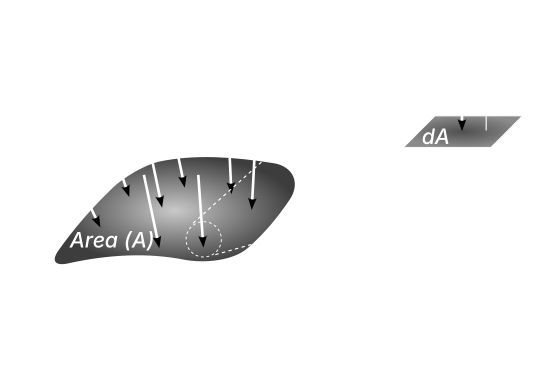
Pressure is the normal force per unit area: P = Fn / A. For infinitesimal changes: dP = dFn / dA
Key Point: Pressure forces always act normal (perpendicular) to a surface.
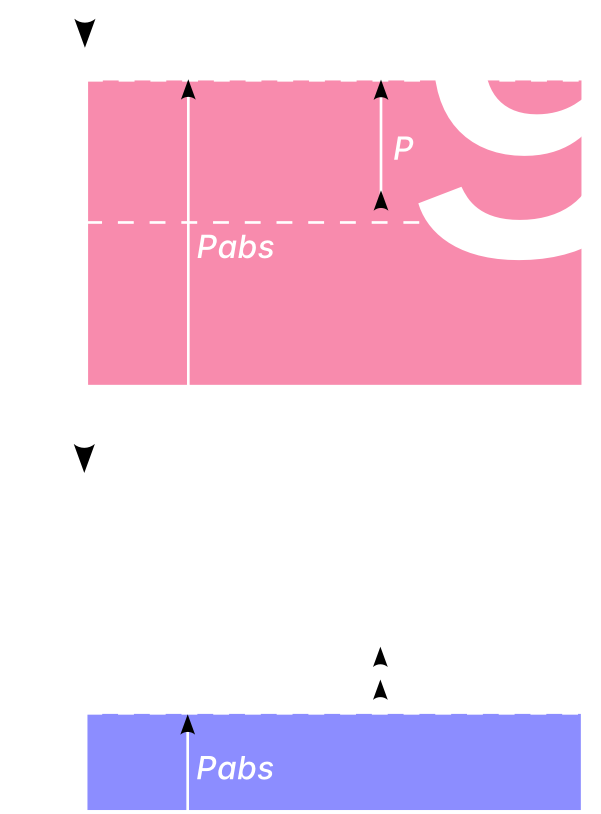
In fluids, the pressure acting on an object can be described as the absolute pressure, Pabs, which is the total pressure exerted on the object, or the gauge pressure, Pgauge, which is the pressure relative to atmospheric pressure, Patm. The relationship between absolute and gauge pressure is given by:
Pabs = Pgauge + Patm
On the contrary, if the pressure is below atmospheric pressure, the gauge pressure will be negative, indicating a vacuum condition. this can also be referred to as the vacuum pressure, Pvac, which is the difference between atmospheric pressure and absolute pressure:
Pvac = Patm - Pabs
Key Concepts
Lecture content coming soon...